
Inactive
Simplifying IT
for a complex world.
Platform partnerships
- AWS
- Google Cloud
- Microsoft
- Salesforce
ACUVI Insight · Actuarial · 2026
Where AI is producing measurable value for actuarial teams in 2026, and what it looks like when an actuary simply asks a long-term care book of business a question.

~80%
Of actuaries already use AI
70%
Of time lost to data and calculation prep
1 click
To see the query behind any answer
<30 days
From connection to go-live
An analysis is only as good as the data behind it and the time it arrives. Most actuarial teams have the right data. They just get it at the wrong time.
AI in the actuarial function isn’t a pilot anymore. The 2026 question for an insurer is no longer whether actuaries will use AI, but whether they’re using it on the work that actually consumes their week.
About 80% of actuaries now use AI, yet most report using it for fewer than five hours a week.1,2 Nearly two-thirds of European insurers are actively using generative AI, but most are still at proof-of-concept, and 64% of use cases target back-office productivity.3
Actuarial talent is scarce and expensive. The U.S. has about 31,200 actuaries, the median wage is $130,000, and employment is projected to grow 9% from 2025 to 2035.4
Adoption is wide but shallow. Actuaries are using AI to draft emails and summarize documents, while the work that eats their week, getting from a question to a trusted number, still runs the old way.
For actuarial teams, the quality of an analysis depends on having the right data at the right time. But getting data to a place where actuaries can work with it often takes coordination between teams, and weeks or even months to achieve.
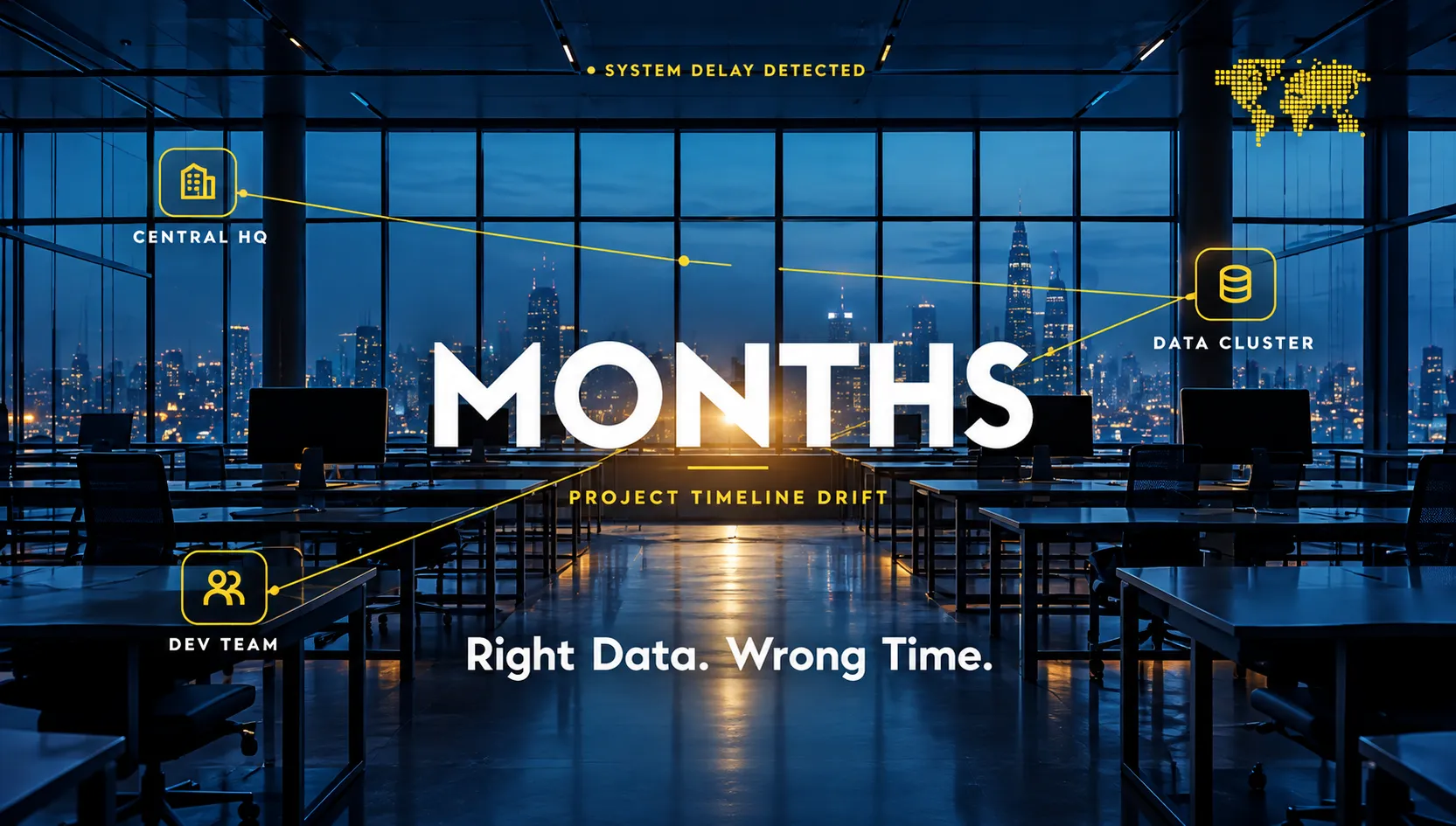
From the InsightIQ film, every hand-off between the business, IT, and data teams adds drift: first weeks, then months.
The traditional path
With InsightIQ
The result: actuaries fit their analysis into whatever predefined reports already exist, or spend hours building workarounds and processing large datasets in desktop tools when a new question comes up that existing systems weren’t designed to answer.
Here’s InsightIQ working on a long-term care insurer’s actuarial dataset, the demonstration environment shown in ACUVI’s product film. Each answer below came back in plain English, with a chart and the query that produced it.
Question 1 · Start broad
“Tell me about my data.”
Not sure where to start? InsightIQ’s neural analytics engine profiles the dataset and surfaces what matters. In this case: a book of 60,000 policies, $2.78 billion in cumulative premiums and $1.79 billion in claims paid to date, along with policy-status mix, issue ages and claim exposure. It also suggests the next questions worth asking.
Question 2 · Go geographic
“Show me geographically where my claims exposure is highest.”
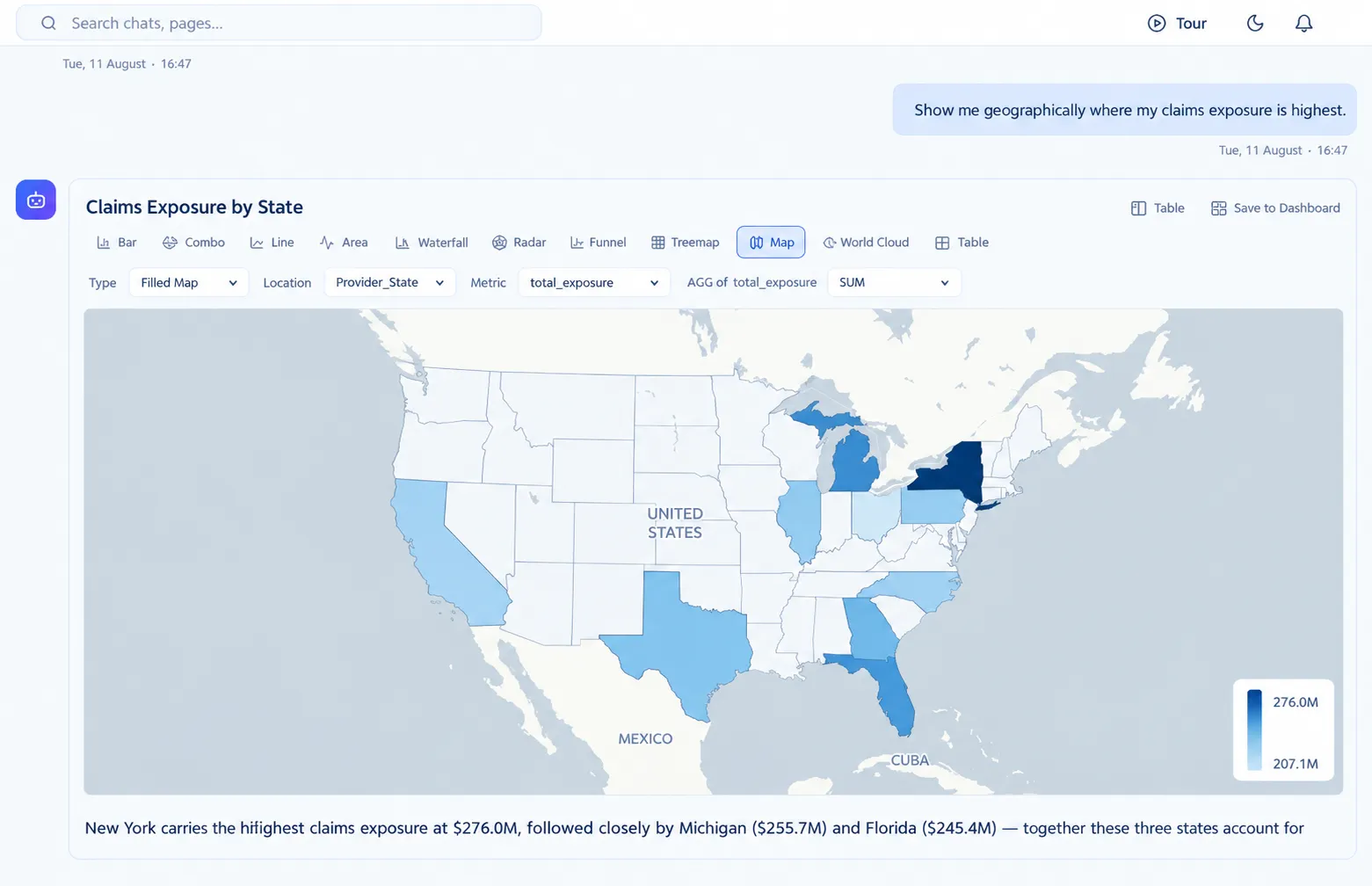
InsightIQ New York leads at $276.0M, followed by Michigan ($255.7M) and Florida ($245.4M): roughly 33% of $2.33B total exposure across 10 states.
Question 3 · Find the driver
“Help me identify the source of the reserve increase.”
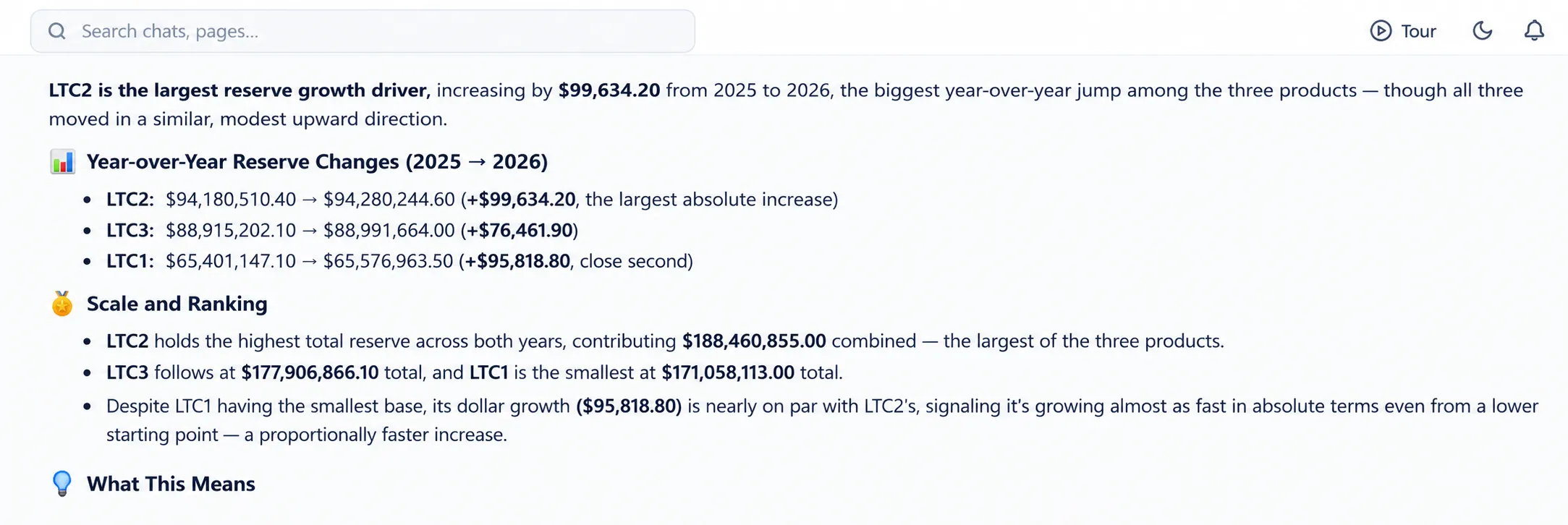
InsightIQ: LTC2 is the largest reserve growth driver (+$99,634.20 year over year), while LTC1 shows the strongest relative momentum from a smaller base.
InsightIQ doesn’t stop at the number. It explains what the result means, flags that LTC2 is the top candidate for a reserve-adequacy review, and recommends follow-ups, such as which states hold the highest reserves for that product.
Question 4 · Show your work
“Where did that number come from?”
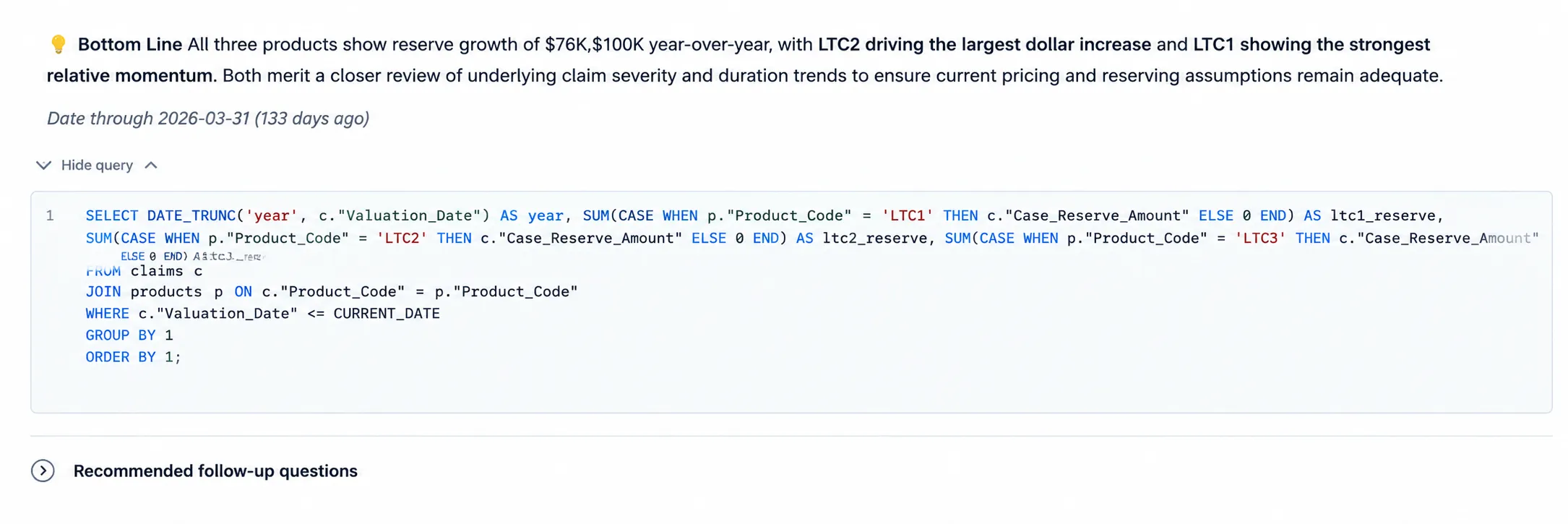
View query: One click reveals the exact SQL behind the result, ready to carry into an audited report or financial statement.
Results an actuary needs to keep referencing go onto a live dashboard in one click: claim duration by type, case reserves by claim type, trigger and cognitive status, and exposure by state, all updating as new data arrives.
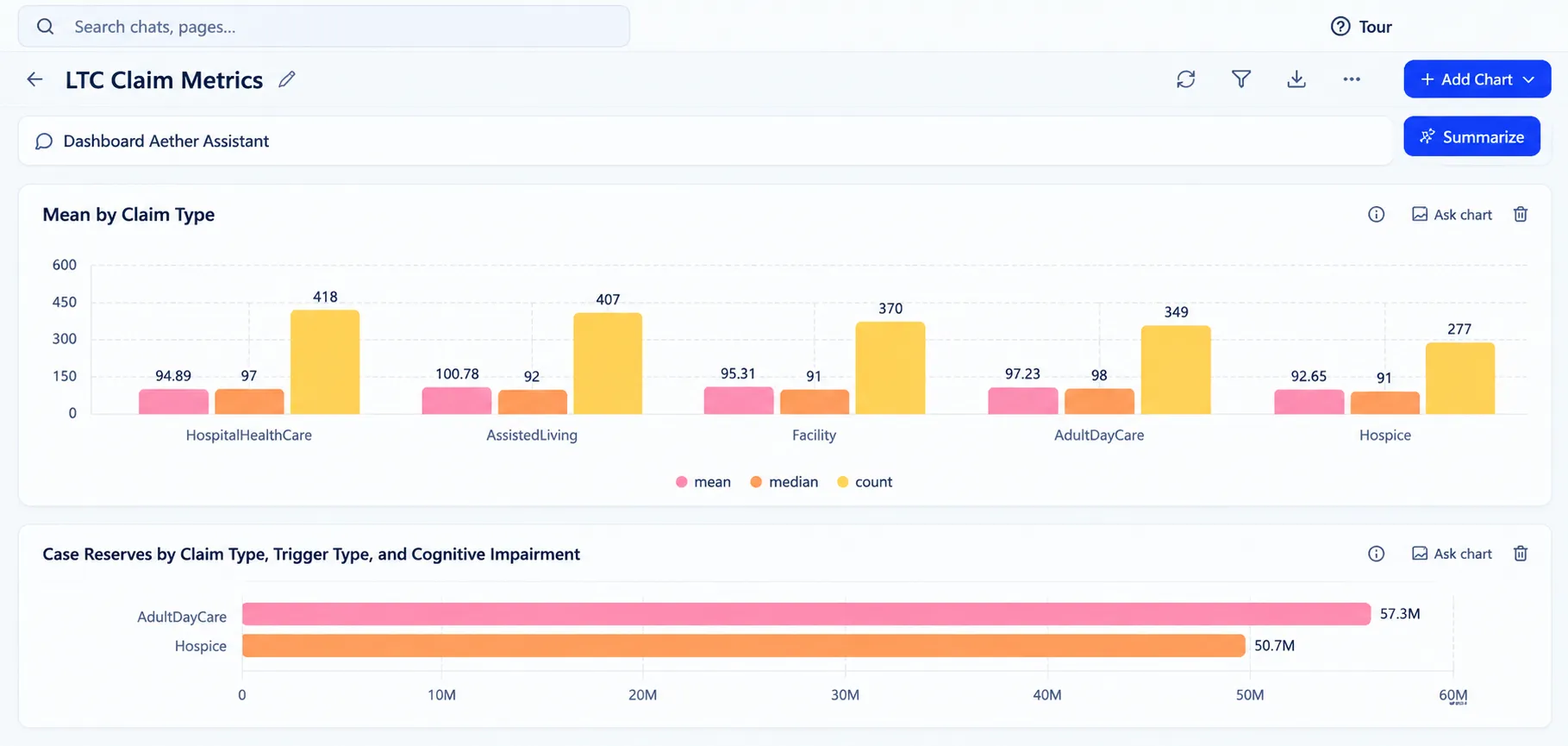
One-click dashboard “LTC Claim Metrics”: answers saved from the conversation become a shared, live view. Figures shown are from ACUVI’s long-term care demonstration dataset, not a client portfolio.
“Spend less time waiting for data, and more time understanding what it means.”
As EY puts it, with AI in the actuarial function, “questions that once took days or weeks to answer can now be addressed in hours or minutes.”6 The demo above shows the five capabilities doing that work:
Ask the way you’d ask a colleague: claim trends, utilization, morbidity, lapse experience, emerging risk, reserve drivers. No SQL, no BI ticket.
Start with “Tell me about my data,” or point it at a specific question, and it surfaces the areas worth a closer look.
Every answer comes with a chart or table, and any of them can be pinned to a live dashboard for stakeholders.
The View Query button shows exactly where each result came from, so every number can be independently regenerated for audit.
New data is incorporated automatically, so teams can test assumptions and evaluate scenarios without waiting for the next refresh cycle.
Accuracy and explainability are top concerns for actuaries in the SOA survey.1 If you can’t reproduce the number, you can’t sign off on it.
Confidentiality and data security rank among actuaries’ main concerns.1
They help with emails, not A/E ratios. That’s the under-five-hours-a-week trap.
The NAIC Model Bulletin sets expectations for how insurers govern AI and the documentation regulators may request.5
Consider a 10-actuary team at the U.S. median wage.4 If 70% of their time goes to data and calculation prep, here is the capacity at stake:
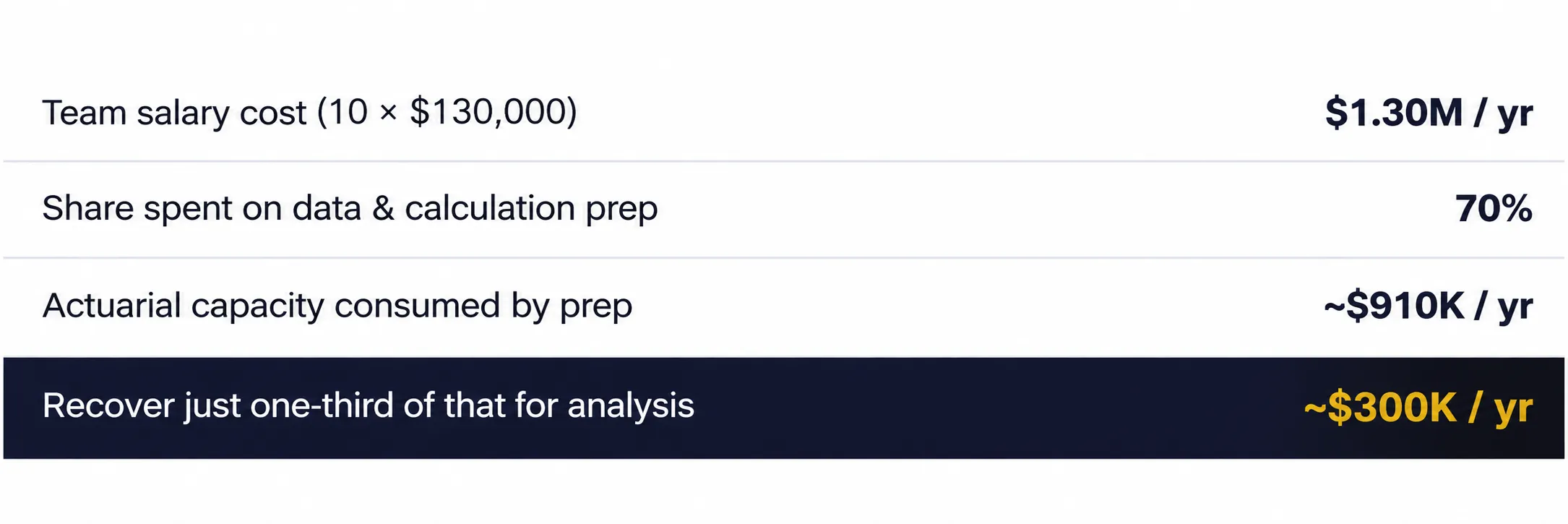
That’s roughly three extra actuaries’ worth of value-add work a year, without a single new hire, in a profession where talent is already hard to find.
ACUVI’s operating belief is simple: operationalize AI with measurable outcomes, and your data is yours, always. For the actuarial function, that’s ACUVI InsightIQ, powered by Ithena.

Built for insurers, deploy on-premises, in a private cloud, or as SaaS from a SOC 2 hosting environment.
InsightIQ connects directly to your existing source systems, with prebuilt connectors and new ones built in days or weeks. ACUVI partners with your IT and data teams for a smooth integration.
It is shaped to your pricing, valuation and reserving workflows, inside your governance framework and in line with HIPAA requirements.
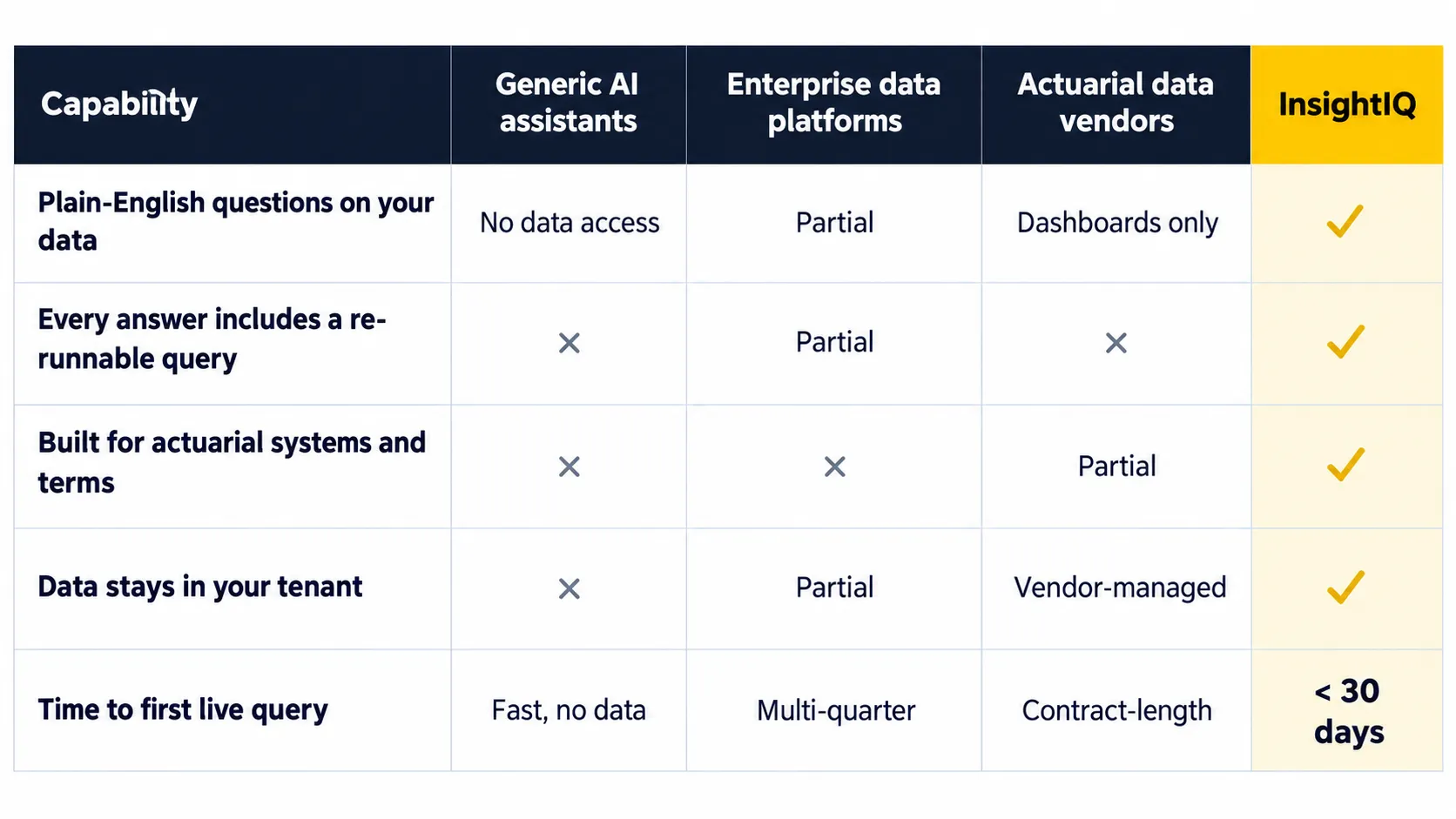
Actuaries ask questions in plain English, and every answer arrives with its query.
Start with one question
Book a 30-minute scoping call. Bring one actuarial question you can’t currently answer in under a day, and we’ll show you a live natural-language query on a sample of your data.